
Right, you are on this blog, reading this because you understand the practical benefits and superior comfort of the men’s thong. They are a great option. But there needs to be a cultural change for the style to be accepted by the mainstream, and this is how to make the change!
(more…)Blog
-
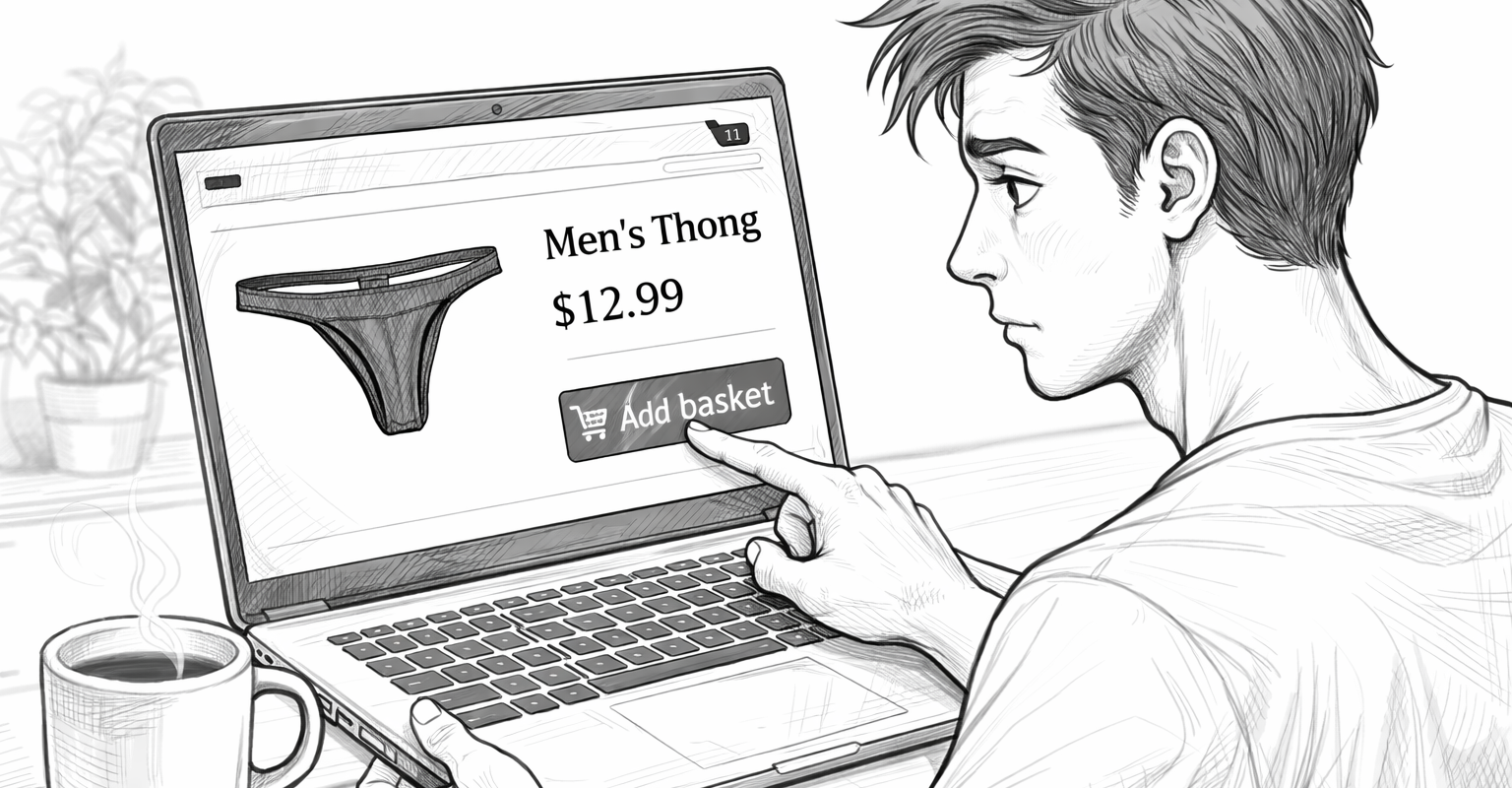
Add to Cart, Buy It, Try It!
Let’s talk about the thing you’ve thought, researched, perhaps even hovered over the “Add to Cart” button for, but ultimately talked yourself out of. The men’s thong.
If you feel a ping of apprehension, you’re in good company. Society has spent decades telling men that their underwear should be bulky, heavy, and utilitarian. But here’s a secret that thousands of confident, active, and well-dressed men have already discovered: The apprehension is entirely in your head, but the comfort is entirely in the fabric.If you’re looking for a sign to finally cross that finish line, here is the motivation you need to stop overthinking and start experiencing.
(more…) -

Why Every Man Should Try Wearing a Thong (At Least Once)
In the world of men’s style, the thong remains the final frontier. It is buried under layers of outdated stigma, hyper-masculine “rules,” and plenty of bad jokes. But if you look past the locker-room tropes, you’ll find a piece of clothing that is surprisingly logical, highly functional, and potentially life-changing for the modern man.
(more…)
If you’ve spent your life in boxers or briefs, here is why it’s time to drop the bias and give the thong approach a fair shot. -

Who Can Actually Tell You’re Wearing a Thong?
One of the biggest hurdles for men trying a thong for the first time is the secret factor. There is a common anxiety that a neon sign is flashing above your head, that the whole world can tell your choice of undergarments.
(more…)
In reality, the thong is arguably the most discreet piece of clothing a man can wear. However, there are specific scenarios and “tell-tale” signs that might give you away to a keen eye. Here is the breakdown of who can tell, and how. -
The First Time I Realised Nobody Noticed
When I first started wearing men’s thong underwear, I genuinely thought people would be able to tell.
Not just if they saw something obvious, like a whaletale high above my jeans, but I had this strange belief that it would somehow be obvious anyway. Like there was no real hiding it. At the time, I honestly felt like people had some kind of awareness I didn’t understand, like x-ray vision, as if they’d just know something was different about me.
The first time I properly tested that fear was at a Halloween party.
I had owned the thong for a while but had been too scared to wear it outside my flat. It stayed hidden, something I would try on briefly at home and then overthink afterwards. But I eventually decided that if I was ever going to wear it out, Halloween was the easiest excuse. If anyone somehow noticed, I could just say it was a hidden part of the costume, a surprise.
Even so, I was terrified.
At the start of the evening, I was extremely self-conscious. I remember constantly thinking about what I was wearing and imagining worst-case scenarios where someone somehow detected it, judged me, or asked a question I wouldn’t be able to answer comfortably.
But something interesting happened as the night went on.
We were playing games, moving around a lot, and eventually heading out to a club. It was on the walk there that I realised something had shifted. I’d stopped actively thinking about it. Not because I’d decided to be brave, but because my attention had just moved onto everything else.
And this really surprised me.
Because I also realised something else at the same time: during all that movement, all that physical activity, nobody had reacted differently to me. Nobody had said anything. Nobody had looked at me in a way that suggested anything was wrong or different.
That created a strange internal conflict.
Part of me still expected that I had been “found out” and people just hadn’t said anything yet. But another part of me started to form a completely new thought:
Maybe nobody could actually tell.
That thought came with a wave of fear at first. If someone had seen, what would they think? What would it say about me? I had all the usual assumptions in my head about judgement, masculinity, sexuality—things I now realise had very little to do with the actual reality of underwear and everything to do with social conditioning.
But then something else happened. That fear quickly softened into acceptance.
Nothing in the external world had changed. People were still behaving the same. Conversations were the same. The night continued exactly as normal. And that created a very simple but powerful realisation:
Even if someone had noticed, it didn’t seem to matter.
That experience didn’t just reduce my anxiety in that moment, it changed how I approached everything afterwards.
The next shift came later, in a much more mundane situation.
I was doing the washing in my flat. I’d been hiding my underwear out of habit, putting it away discreetly, overthinking even the act of drying it by hanging thongs up to dry in my cupboard. But one day I came back and my flatmate had already hung everything up to dry for me. Including the thongs.
I remember the immediate spike of embarrassment. That instant thought of: this is it, she’s seen it, she’s told everyone else in the flat. I assumed she would think something about me—maybe that I was gay, or into something sexual or unusual, or that it meant something about my personality.
But nothing happened.
No reaction. No comment. No change in behaviour. Just normal life continuing.
Instead of reinforcing my fear, it actually did the opposite. I started to realise that most people are not analysing your underwear, or building narratives about your life based on it. They’re just too busy living their own lives.
That experience made it easier to stop worrying about strangers as well.
Over time, there were other moments too—bending down in shops, going through airport security pat-downs—situations where I was absolutely convinced someone must have seen something. But even then, nothing ever came of it. No reactions. No shifts in behaviour. No consequences.
And gradually, that changed the way I interpreted everything.
I stopped looking for “evidence” that people had noticed, because there never really was any. Instead, I became more curious than anxious. If someone did see, what actually would happen? And over time, that curiosity replaced most of the fear.
What I’ve realised is that most of the anxiety came from imagined judgement rather than actual experience. The reality was far more neutral than I expected.
But there’s still one area where that shift isn’t completely finished.
With strangers, it’s easy. There’s no context, no relationship, no ongoing meaning attached to a moment. But with people close to me, it still feels different.
The hardest part wouldn’t be someone seeing. It would be their reaction in the moment, and what they might think about me afterwards. I know logically it’s just underwear. I could explain it clearly in terms of comfort, design, and practicality. But I also recognise that social assumptions around men’s underwear choices still exist, and those are harder to control than facts.
So for me, that’s the remaining tension: not the being noticed, but the interpretation.
Because once you realise nobody notices in everyday life, the real question stops being “can people tell?” and becomes “what does it mean if they do?”
And slowly, over time, even that question starts to matter less than you think.
-

Fix your Posture: Try a Men’s Thong
When we think about posture correction, we usually envision rigid back braces, ergonomic chairs, or tedious physical therapy exercises. We rarely think about our underwear.
(more…)
However, there is a growing school of thought among athletes and regular wearers that the minimalist design of a men’s thong offers more than just aesthetic benefits. By changing the way you perceive your body’s alignment, a thong can act as a subtle, all-day reminder to stand tall. -
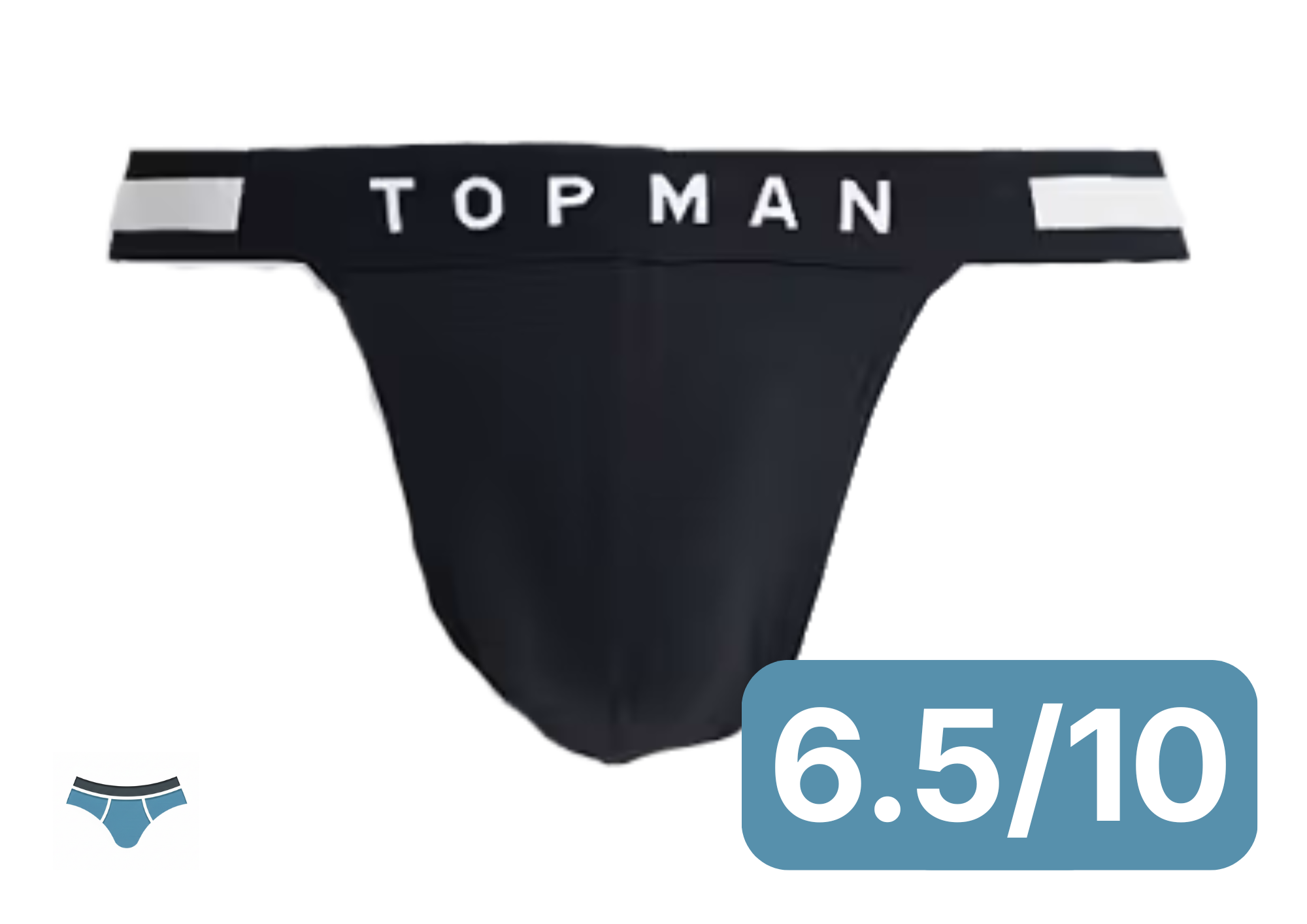
Topman Men’s Thong Review
A thong that holds itself in place well throughout the day, but continues the Topman legacy of low-volume, uncomfortable pouch design.
Quick Summary
Size: Small (3-Pack)
Price: £20 for 3 (~£6.67/pair)
Strap Width: 3cm
Rating: 6.5/10
Best For: Days with a lot of casual movementAbout This Thong
Topman was the big mainstream high-street brand of my teens and twenties, so when I saw they briefly offered a thong through ASOS, nostalgia took over and I had to try it. I could only get a size Small, but at £20 for a 3-pack, it was worth testing out.
First Impressions
Out of the pack, the construction is fairly standard and traditional. It features a thick cotton front pouch and backstrap attached to an elastic waistband, very similar to the classic Calvin Klein thong.
Comfort & Fit
The Pouch
My memory of Topman boxers was always fun designs paired with fairly flat, restrictive pouches—and their thong follows that exact pattern. While sizing down to a Small contributes slightly, the pouch pattern itself is definitely cut quite flat. It takes some initial positioning to get everything sitting right.
The Backstrap
The 3cm thick cotton backstrap is actually the best part of the design. It works really well, offering a sturdy, comfortable feel that doesn’t move or distract throughout the day. The smaller size doesn’t seem to effect the tension.
The Waistband
This is where sizing down generally has the biggest effect, and these fit notably tighter, but the elastic does a good job of adapting so it doesn’t cut in.
Everyday Performance
Once you get everything positioned initially, it holds everything tightly locked in place all day. I find they’re a great option for days with a lot of general movement, though the traditional thick cotton isn’t the best fabric choice for workouts or sweat-heavy activities.
What I’d Change
The front pouch needs a serious redesign with proper 3D contouring and volume. Creating more room up front would eliminate the need to fuss with positioning and make it far more comfortable out of the gate.
Final Verdict
I still like wearing these, especially for casual days when I want a solid, locked-in feel. However, I feel like until Topman updates their approach to the flat front pouch pattern, it remains a mid-tier option. I’m glad to own the pairs that I do, and would buy Topman thongs again if they ever came back, but that’s mainly to show theres product demand to the company
Overall: 6.5/10
-
“If Topman Sold Thongs, I Think Everyone Would Wear One”
The Moment My Flatmate Accidentally Understood the Appeal.
At the time, I still treated men’s thongs like some kind of hidden side project. I had already gone through the first awkward stage of secretly buying one from Primark, convincing myself everyone would somehow know I owned it, wearing it briefly, panicking, then slowly coming back to the idea again later.
By this point, my flatmate already knew I owned one thong. That barrier had been broken earlier through a mixture of curiosity, joking around, and me trying to make the whole thing seem less serious than it felt in my head.
But despite that, thongs still existed in this strange category mentally: something unusual, slightly taboo, and definitely not normal men’s underwear.
Then something unexpected happened.
I Bought Him One Too
At some point during another shopping trip, I decided to buy my flatmate his own thong. Partly as a joke. Partly out of curiosity. And partly because I genuinely wanted to know whether my experience had been unique or whether someone else would react the same way physically.
Because by then I already knew something important: the actual wearing experience was nowhere near as uncomfortable as people imagine.
The mental reaction was the uncomfortable part.
The Immediate Reaction Wasn’t What I Expected
What surprised me most wasn’t that he tried it, it was how quickly his reaction changed once he actually wore it. There wasn’t some dramatic moment of horror. No “How do you wear these?” No “This is unbearable.” Instead, there was this almost confused surprise that it was… comfortable. Genuinely comfortable.
That’s what led to the line that stuck with me ever since:
“If Topman sold thongs, I think everyone would wear one.”
And honestly, that sentence perfectly captured something I had been slowly realising myself.
The Problem Was Never Really the Underwear
That comment stuck because it accidentally exposed the real issue around men’s thongs. The barrier was never the physical experience. It was branding, expectation, and stigma. If a mainstream high-street men’s clothing shop had sold thongs alongside boxers and briefs, most men would probably have viewed them completely differently.
Not as a statement. Not as something “other.” Just another underwear option.
Familiar Branding Changes Everything
The Topman comment was funny, but there was a deeper truth underneath it. People trust familiar categories. If something is sold in the “normal men’s section” by a mainstream brand next to everyday basics, then people subconsciously assume it must be socially acceptable.
But when something feels hidden away, novelty-focused, or oversexualised, you’ll automatically treat it differently before you’ve even touched the fabric.
That changes the entire emotional experience around trying them.
The Physical Reality Was Surprisingly Universal
What struck me most was that his reaction mirrored my own first experience almost exactly. Not emotionally, physically.
Less fabric. Less bunching. Less movement. A surprisingly unobtrusive back strap. The comfort itself wasn’t difficult to understand once you removed the assumptions surrounding it.
It Changed How I Thought About Stigma
Up until then, I still partly viewed my interest in thongs as something highly unusual.
But seeing someone else independently arrive at the same comfort conclusion made it harder to believe the idea that they were inherently bizarre.
It highlighted how much of the stigma came from perception rather than experience.
The Funny Thing About Men’s Thongs
The strange irony is that most people who have never worn one imagine them as extreme, uncomfortable, impractical, or purely sexual. Meanwhile, many people who actually try them end up talking about the support, how comfortable the back actually is, and forgetting they’re even wearing them
It’s a surprisingly practical conversation hidden underneath a very impractical reputation.
I still think about that Topman comment sometimes because it captured the whole subject better than most serious discussions ever could.
Not because it was making some grand statement. But because it recognised something simple. The biggest barrier to men’s thongs usually isn’t the underwear itself, it’s the idea people already formed about them before they ever tried one on.
Years later, when Topman was absorbed by Asos, they did release a line of mens thongs. With my flatmates words still ringing in my ears after all that time, I hit purchase.
-
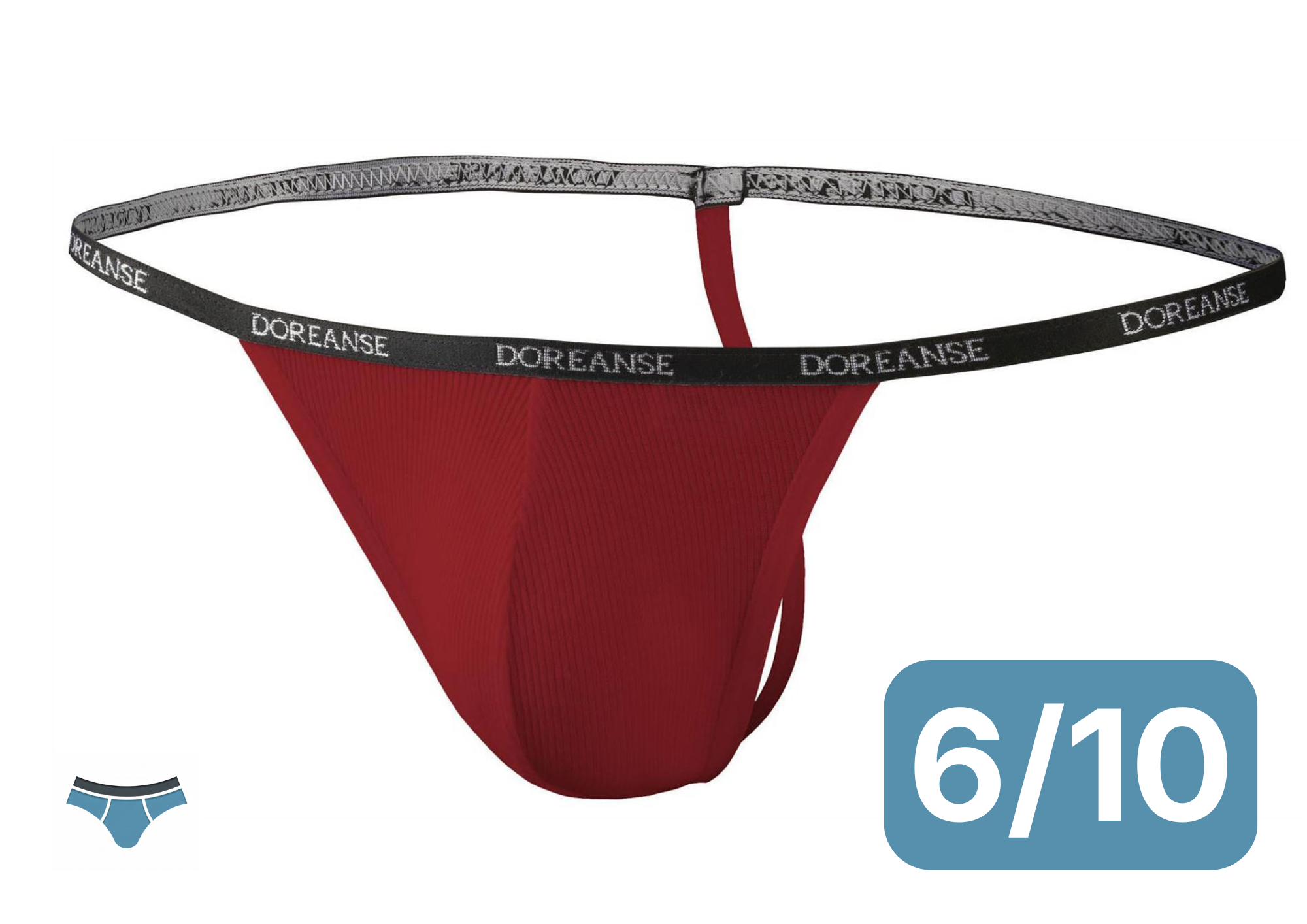
Doreanse 1330 ECO Thong
A minimal G-string that manages to stretch and support despite its tiny size, but the material can feel grabby against the skin.
Quick Summary
Brand: Doreanse (Eco)
Price: £7
Thong Width: 1cm
Size I wear: M
Overall Rating: ★★★☆☆ (6/10)
Best For: Office work and low-activity days
About This Thong
Doreanse have plenty of thongs on offer around this price-point, but this often just comes out as cheaper than the rest, making it a low-cost option to experiment with. Even though I’ve not had much luck with G-strings in the past, I thought I should see how this one held up.
First Impressions
When I first took them out of the packaging, there was very little to them. The 1cm g-string backstrap looked incredibly thin at first glance, but it is actually constructed from a few layers of the fabric, giving it some unexpected thickness and firm stretch. However, the pouch looked so small that I was genuinely worried I wouldn’t even be able to fit into it. The waistband is the exact same as their Aries thong, a branded elastic that isn’t super soft, but looks like it will stay in place.
Comfort & Fit
The Pouch
Fortunately, the micromodal material has plenty of stretch, allowing the pouch to actually fit really well despite its tiny appearance. It provides a minimal level of support that is naturally confined by the pouch size, leaving things feeling loose and stretchy, but not overly so.
The Back Strap
The backstrap is noticeably shorter than the majority of thongs, ending right at the top-end of the butt crack rather than the area above it. Because the fabric is a bit grabby on the skin, I found the initial placement required some deliberate positioning to get the pouch where it needs to be.
It is initially distracting because it holds the waistband lower than usual, but that feeling eventually fades. While the grabby material keeps it firmly in position without needing constant adjustments, it can feel distracting because it occasionally feels like it’s stuck to you.
The Waistband
Despite sitting in a much lower position than a standard thong due to the short strap, the waistband operates perfectly fine. It holds its ground and works really well.
Everyday Performance
These are perfectly fine when you are stationary, making them very well-suited to office work where you spend most of your time sitting down. However, they aren’t entirely seamless when transitioning to physical activity. Whenever you stand up and first start moving, it takes a few seconds for the sticky fabric to shift, find its position, and settle into place.
Pros & Cons
Pros
- Highly stretchy micromodal fabric allows the small pouch to fit well
- Waistband works perfectly and stays secure despite the low-rise position
- Multi-layered 1cm strap adds a bit of durability and thickness for a g-string
- Stays firmly in place without needing ongoing adjustments once positioned
Cons
- Grabby material can create a distracting “stuck” sensation on the skin
- Shorter backstrap demands very precise initial positioning
- Requires a brief “settling period” to find its place every time you start moving
What I would change?
I would change the material to something smoother that can easily glide against the skin to eliminate that stuck feeling. I would also prefer a wider backstrap option, even though this specific design is relatively comfortable for a g-string.
Final Verdict
I probably would not recommend these, as there is simply too much thought that goes into getting them positioned right, and the grabby material could easily turn people away from the style. They are best suited for stationary settings like office work. While I still choose to wear them from time to time, I definitely would not buy another pair.
Overall: ★★★☆☆ (6/10)
-

So, You Tried a Thong and Hated It? Here’s Why (and Why You Might Be Wrong)
Let’s be real: for a lot of guys, the first time trying a thong usually ends with a frantic trip to the bathroom to change back into boxers. It’s a polarising piece of gear. If your first experience felt like a relentless wedgie or a structural failure, you aren’t alone.
However, before you decide forever that thongs just don’t work for you, it’s worth diagnosing why they failed. Usually, it’s not the style, it’s the execution.
(more…)